
ORDER UP
Well whiskey with a side of salty tears
I became a person working in restaurants. Waitressing and bartending (and bussing and hostessing) taught me pretty much everything I know that isn’t directly related to cultural theory or the Canadian media industry. I learned how to correctly serve wine, how to deftly navigate uncomfortably sexist situations, how to remember everything under pressure, how to flirt, how to lie, and that a smoking habit means more opportunities to breathe. I learned that most people are assholes and that definitely almost all chefs are. I learned that a sky-blue polyester polo shirt is not the greatest look for me. Ditto bow-ties. I formed strong opinions about proper Caesar ingredients and how much to tip (abolish tipping! but also, in these pandemic times, tip >30%!), and I firmly believe that cannoli filling on crusty bread is a perfect snack.
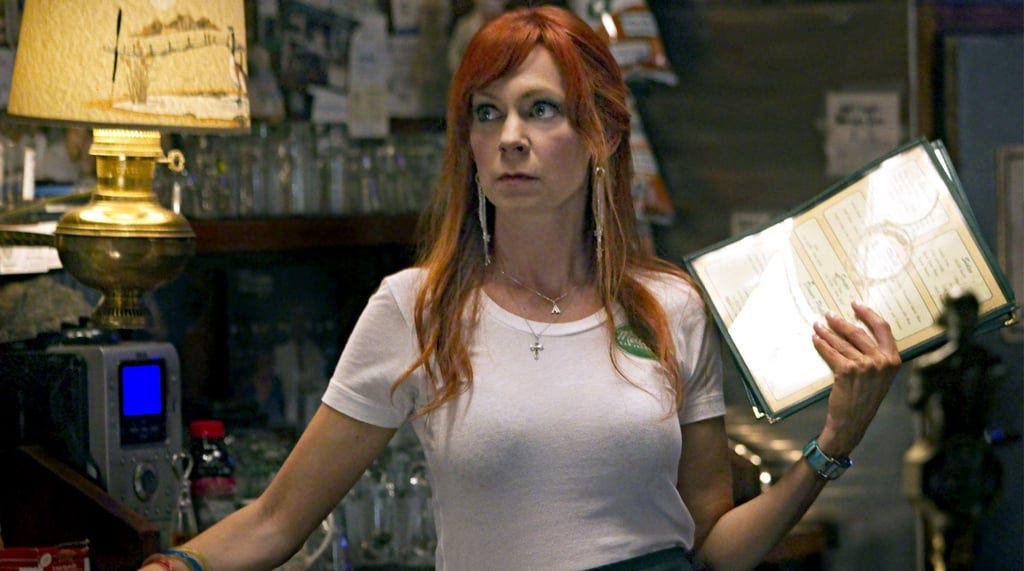
I worked long enough in restaurants that it became part of my Identity, which mostly meant that I was unable to maintain an emotional distance whenever I consumed restaurant-related content. I love it when it’s good: PARTY DOWN is one of my favourite TV shows, SUPPORT THE GIRLS is criminally underrated, and I watched the entire (bad, but smart about restaurants) adaptation of Sweetbitter after reading the book. I will always get upset, irrationally so, at things that pop culture gets wrong about working in restaurants (far too many examples; but for one, in THE DEVIL WEARS PRADA, why was Anne Hathaway’s boyfriend, That Guy from Entourage, always home to cook her dinner and patronize her career even though he is supposed to be a chef?) Spiritually, I sometimes feel like a down-on-her-luck waitress in a hick-town diner, like Carrie Preston in TRUE BLOOD or Keri Russell in WAITRESS (ugh, my heart!). I also love movies with elaborate bar settings—PULP FICTION, BOOGIE NIGHTS, COYOTE UGLY. Knowing this, I fully expected to love BLOODY NOSE, EMPTY POCKETS, a movie that came out earlier this month. But! I did not! Or at least I think I didn’t.
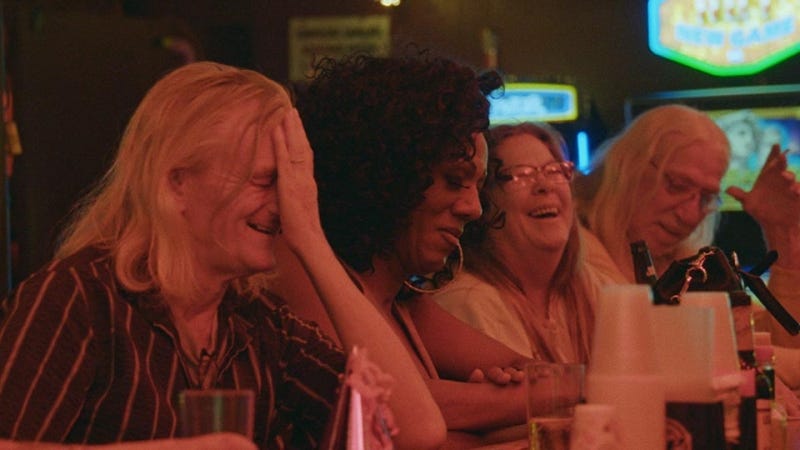
The thing about BLOODY NOSE, EMPTY POCKETS is that it feels like a perfect movie for Summer 2020: it makes you very sad, a little bit nauseous, and it’s all a scam. The movie follows a group of regular patrons of a dive bar in the outskirts of Las Vegas. The bar is closing, and the entire narrative is contained to its final celebration. It’s very “one last hurrah” and also a (literal) bottle episode. It has everything you want from a good, digestible documentary: quirky premise, well-established setting, wildly charismatic characters. It feels almost too good to be true, that a documentarian came across this story and was able to capture it, and that’s because… it is! The bar in question is in New Orleans, not Las Vegas, and it’s still open. The characters are amateur actors, cast specifically for the film. The scenes are for the most part unscripted, and it feels spontaneous because it is, but it also feels deceitful once you know the real story.
Not to be that person, but some of my favourite films blur the line between fiction and nonfiction. Often, like BLOODY NOSE, they’re also about people living on the fringes of society—I’m thinking of AMERICAN HONEY here, and TANGERINE, and HEAVEN KNOWS WHAT, movies that use non-actors to tell their stories (but those don’t claim to be documentaries). If this movie is like those three at its best, it’s NEBRASKA at its worst (remember that terrible movie? No? Good!), which means that it seems like someone with a camera discovered the concept of poor people. It often feels exploitative, zooming in on people’s faces as they get drunker and drunker. There’s a truly painful scene where the patrons watch an episode of Jeopardy!, baffled by the questions, and the camera is unrelenting. I strongly disagree with critic Matt Zoller Seitz’s claim that this is a “documentary of compassion”—neither of those words apply here.
I think BLOODY NOSE is a documentary, but not about a bar. I think it’s a documentary about how certain artists look at the world. "Everything’s a fucking documentary," one of the filmmakers said in an interview, which is technically true, but this world is fabricated in order to create a Certain Type of Narrative, a look at Struggling America and Social Issues. The narrative isn’t the issue; it’s the fabrication that needs to be examined. Take this quote from the director, on the challenges of casting and staging this movie: “Either the bar aesthetically looked correct and the people inside it weren’t, or you’d find a bar where maybe a couple of people worked, but the bar wasn’t right.” What do the phrases “right” and “correct” mean here? Sure, all documentaries are staged to some extent, and maybe the binary between nonfiction and fiction is just absolutely irrelevant these days, but that kind of thinking still makes me queasy. As critic Richard Lawson points out, “if one is going to embark upon a project that shows people in all their true, lived-in, articulated being, how curatorial can that project be?”
One positive thing about the movie, which brings me back to the beginning of this newsletter, is that it made me realize: god, I miss bars. I miss first-date bourbon at dive bars and I miss post-event bourbon at hotel bars. I miss forming brief bonds with strangers from either side of the counter. I miss dim light. I miss the places that made me a person.
I’m reading Nora Loreto’s upcoming book Take Back the Fight, in which she argues that “one of the goals of neoliberalism has always been to crush community.” She’s writing about feminist activism in the digital age, but her argument that a return to organizing and community-building is essential to progress, especially a time of such fractured discourse, is applicable beyond that scope. This is why, I think, everything feels so insurmountable right now: not only has the pandemic fully exposed the violence and destruction going on in the world, it has also taken away the power of convening. The worst bartending shifts were the times I was alone, the only one on staff, with no one to commiserate. When I worked as a counsellor on a crisis line, it was the moments of silence in between calls that I couldn’t stand. (Now, for those of us working alone in our homes, that feeling is constant). There are spaces that are built from an intricate web of human interaction, whether that’s a social justice organization or a dive bar, and for all its questionable ethics, this movie gets that. If nothing else, it’s a perfect relic of this time.
RECOMMENDATION FROM THE ARCHIVE:
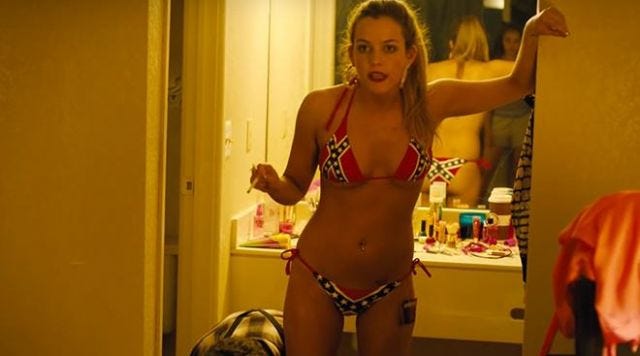
Since I mentioned it earlier, and since we’re all horny for Shia LaBeouf lately: watch AMERICAN HONEY! It’s a delight, pure escapism and emotion, and Andrea Arnold is a directorial genius. Plus, Riley Keough’s performance will get you hyped for ZOLA.
OTHER THINGS I’VE LIKED LATELY:
Here’s a documentary (no quotation marks) that I did like: BOYS STATE! BOYS STATE is fantastic. If you feel like the future of politics is doomed like 95% of the time, but you still try to be optimistic for the remaining 5% because otherwise how could you even wake up in the morning, this is probably the movie for you. BOYS STATE is about a camp program for teen dudes that teaches them about politics, and it follows four of those dudes over the course of their mock campaigns. A ton of very successful politicians went to Boys State, so it’s not unlikely that you’ll see these little twerps in some form of office in the future—check out this piece by René Otero, one of the featured campers, if you don’t believe me. (NB: at times, the movies veers into the growing documentary genre of “liberal elite navel-gazing”—unavoidable, probably, since it’s co-produced by Democratic donor and billionaire Laurene Powell Jobs. If you’re looking for radical ideas and you don’t care about what the youths are up to, look elsewhere).
I’ve been struggling to articulate how I feel about the fact that newsletters seem to be the new media reality—there is still something icky to me about how important “personal brands” have become in journalism, although I know that this is obviously hypocritical of me, writing this here. Still, I’ve found some that I really enjoy receiving (for free, sorry, the bulk of my money goes to print magazines already). Anne Helen Petersen’s latest on COVID influencers (speaking of icky personal brands!) is extremely smart, everything Alicia Kennedy writes about feels like it’s cracking my brain open a tiny bit more, and now my #1 Mom Alanna can be your mom too! (make all her dessert recipes! trust me!)
Allow me to be a broken record once again: the finale of I MAY DESTROY YOU aired, and it was unsurprisingly perfect. This show felt like a gift from some secular art deity, something that was created in a higher realm. It hit every one of my nerves. It made me feel active in a way that I think I had lost in the last six months, that all of us had lost. As magical as it was, the show understood what it means to be a human in the world, and it showed us in an impossibly creative way, and I, for one, needed that.
If you like this, you can subscribe to hear more of my scattered thoughts, and please email me if you want more suggestions! And please send me other newsletters you like, or your thoughts about newsletters in general. And eat a peach outside, because life is short.